
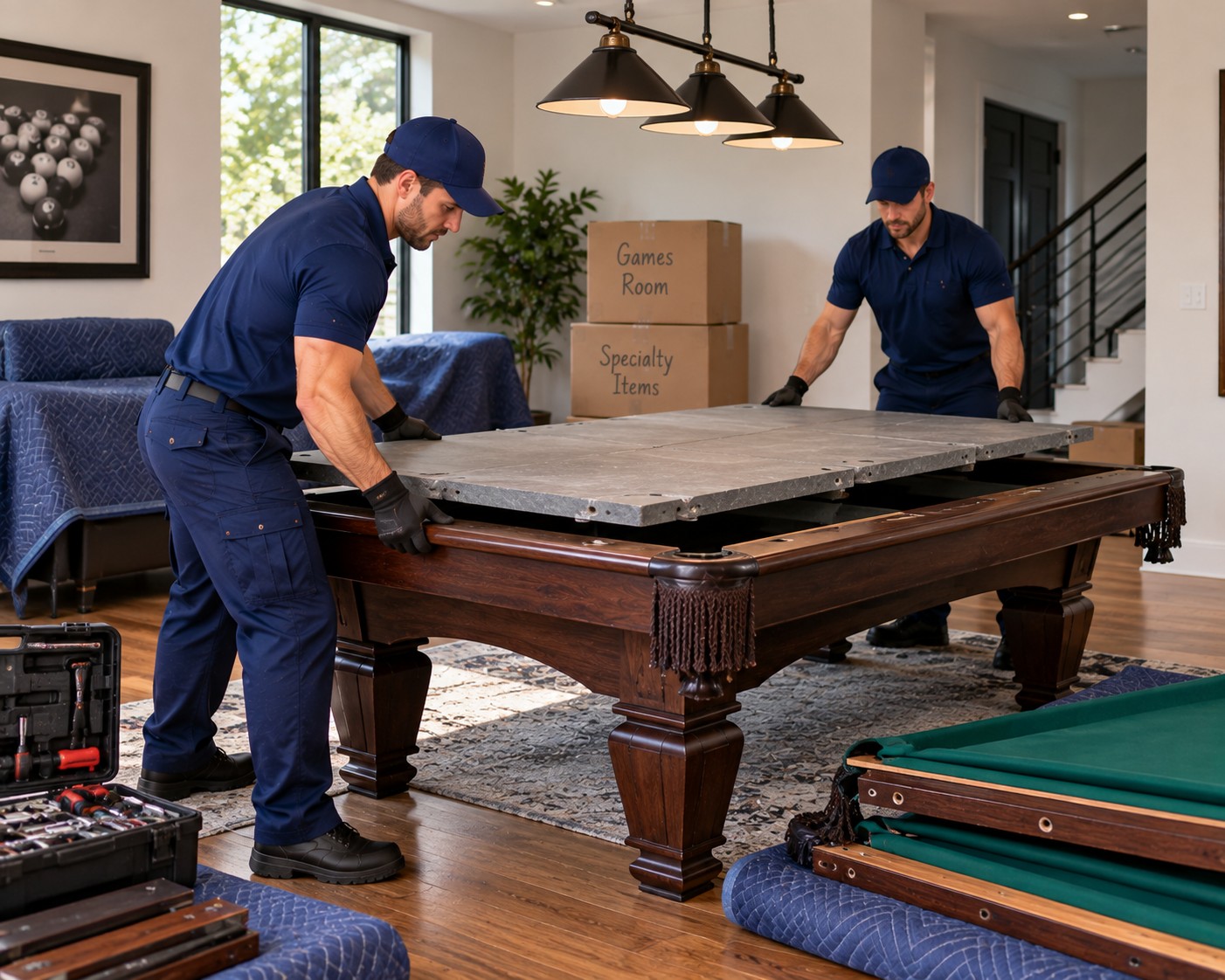
A pool table can look deceptively straightforward from across a game room. Once it needs to leave that room, however, its dimensions become a major logistical factor. The table may need to pass through narrow doorways, travel down stairs, fit into an elevator, or make several turns before reaching the vehicle.
Different pool table sizes can therefore require different preparation strategies. Measuring the table itself is only the beginning. The route, construction, weight distribution, and destination all need to be considered before moving day.
Start With the Exact Table Dimensions
Pool tables are available in several standard sizes, but the actual exterior dimensions can vary depending on the manufacturer, frame design, pockets, rails, and cabinet construction.
Measure the full table, including its widest and longest points. Record the height as well, particularly if the table will need to pass beneath low door frames or through restricted spaces.
Measure more than the table
The surrounding route matters just as much.
Check:
- Doorway widths and heights
- Hallway clearance
- Staircase dimensions
- Elevator capacity and opening size
- Turns and corners
- Garage or loading access
A table that fits through the front door may still be impossible to maneuver around a tight hallway corner.
For professional moving assistance with oversized recreational equipment, Price Movers provides information at https://pricemovers.com/.
Understand Why Size Affects Weight
Larger pool tables generally require more substantial frames and playing surfaces. Slate tables in particular can be extremely heavy, with the weight distributed across several components.
This makes carrying technique especially important. Movers need to understand where the weight is concentrated before lifting or tilting anything.
A large table should never be treated like ordinary household furniture. Its dimensions can affect how many people are required, what equipment is useful, and how the route should be managed.
Plan for Disassembly
The size of the table may determine how extensively it needs to be dismantled.
Depending on its construction, preparation can involve removing pockets, rails, legs, frame components, and the playing surface.
Protect each component separately
Once disassembled, components should be labeled and protected individually.
Rails can be vulnerable to scratches and impacts. Slate sections require particularly careful handling because cracks or edge damage can compromise the table.
Keep screws, brackets, bolts, and other hardware together in clearly marked containers. Photograph complicated connections before disassembly so the table can be reconstructed accurately at the destination.
Consider the Moving Route Before the Table Leaves the Room
A large pool table can expose problems that might otherwise remain unnoticed.
For example, an eight-foot table may be manageable through a particular doorway while a larger model requires a different route. Staircases can become especially challenging when there is limited turning space.
Do not wait until moving day to discover that a table cannot make the final turn.
Measure difficult points twice
If a passage is only slightly wider than the table or its largest component, account for the need to angle and rotate the object.
Also consider handrails, light fixtures, wall protrusions, door hardware, and other obstacles that reduce usable clearance.
Protect the Playing Surface
The playing surface deserves particular attention during preparation.
Slate should be handled carefully and supported appropriately. It should not be exposed to unnecessary impacts or placed where other components can fall against it.
The felt and rails also need protection from dirt, moisture, friction, and sharp edges.
Avoid placing loose hardware or tools directly on finished surfaces during preparation.
Think About the Destination in Advance
The new room can influence the preparation just as much as the original location.
Measure the destination doorway and determine where the table will ultimately stand. Leave enough room around it for comfortable play and cue movement.
If the table will enter a newly renovated room, protect finished flooring and walls along the delivery route.
Choose Handling Methods Based on the Table
A small, lightweight table and a large slate tournament-style table should not automatically receive the same moving plan.
The size, construction, weight, and route determine which handling methods are appropriate.
Professional pool table movers can evaluate these factors before transportation and organize the preparation accordingly. More information about specialized service is available at https://pricemovers.com/services/moving-of-large-cargo/pool-table-movers.
Give Measurements a Central Role
Pool table size influences nearly every stage of the move, from route planning and disassembly to manpower and protective materials.
Instead of treating dimensions as a basic measurement for transportation, use them to build the entire preparation plan. When the table, its components, the building, and the destination are evaluated together, potential obstacles become much easier to identify before moving day.
That preparation helps protect both the table and the property while making the relocation far more controlled.
[…] Read more Bigger Table, Bigger Plan: How Pool Table Size Influences Moving Preparation […]
[…] Read more Bigger Table, Bigger Plan: How Pool Table Size Influences Moving Preparation […]
[…] Read more Bigger Table, Bigger Plan: How Pool Table Size Influences Moving Preparation […]